Showing posts with label theology. Show all posts

Thursday, December 27, 2012

Advent 2012: Week 4

Week 4 of Advent is very short this year!  Here's how we prepared in the couple of days before Christmas.

December 22: Originally, I planned to make marshmallows to have in hot chocolate, but after a playgroup friend gave us this snowman
 I decided not to make work for myself!  We went for a family walk around the 'park' area of our apartment complex and then came back and made minty hot chocolate.  I took the picture after I'd made the drinks so just in case you can't tell, his head contains tiny (hard) marshmallows, his middle contains hot chocolate powder, and his base contains peppermint candy which was heated with the milk.  (I couldn't be bothered crushing it, as instructed, but it seemed to infuse fine.)  J thought this was a fantastic treat.

December 23: We lit the fourth candle on our Advent wreath, symbolizing love.

December 24: Today we retold the Christmas story with a kid-friendly nativity.  In the afternoon we attended the Children's Christmas service at church.  Then in the evening we skyped with family in NZ, where it was already Christmas Day.  After both boys were finally in bed, we nestled presents under the tree since they'd been out of sight to avoid prodding and poking!
 December 25: Christmas Day!  Among our other activities for the day we lit the final candle at the centre of our Advent wreath: the Christ candle.  After all, Christ's coming is the reason we have the preparation time of Advent and the reason we celebrate Christmas in the first place.

Merry Christmas everyone!

Friday, November 30, 2012

Advent 2012

We are in the season of Advent, the start of the Church's liturgical year.  It's a time of preparation for Christmas, a time to prepare our hearts and minds to celebrate the wonder and joy of God's gift of Jesus.

We'll be reflecting on the liturgical season with an Advent wreath this year.  While not a church tradition, my family also has an Advent calendar (made by my talented mum) that we use to 'count down to Christmas' each December.  Each pocket at the base of the banner contains a felt ornament that is velcro-ed to the tree in the centre each day.  We'll also be reading from the Jesus Storybook Bible each night as part of our countdown.

Maybe because C has been sick with Hand, Foot and Mouth disease a few weeks ago (read: contagious and we were all sick of being at home in quarantine) I have made a list of 24 activities I'll attempt to do with the boys too.  I might be too ambitious!  Here's my list:

December 2012

  1. decorate our tree
  2. light first candle on our Advent wreath 
  3. play Christmas music CDs
  4. send Christmas cards (in the hope they'll arrive in time across the world!)
  5. colour a printable nativity set 
  6. make our Christmas cake
  7. read about Saint Nicholas
  8. hang a treat for the birds
  9. light the second candle on our Advent wreath
  10. make gingerbread cookies
  11. build a 'gingerbread' house out of graham crackers
  12. make paper snowflakes to decorate (since it is unlikely we'll see the real stuff)
  13. make some Chex mix (a standard snack food around the US during this season)
  14. 'spring' clean our house
  15. watch a Christmas movie (maybe this one?)
  16. light the third candle on our Advent wreath
  17. drive to see some Christmas lights in a nearby neighbourhood
  18. make peanut butter squares (that taste like like Reese's PB cups - yum!)
  19. make gift tags
  20. wrap presents
  21. make marshmallows for hot chocolate
  22. make a donation to the Salvation Army (the bell-ringers are outside our nearest store)
  23. light the fourth candle on our Advent wreath
  24. attend the Christmas Eve service at church (they don't really do it Christmas Day here)and skype with family in NZ (where Christmas will have already arrived)
  25. light the central 'Christ' candle on our Advent wreath and revel in our celebration of God's grace-filled gift of Jesus!


Monday, October 22, 2012

Braggin' on my Man

N has had a number of pieces of work published lately, and one came in the mail yesterday, so it is high time I shared the links with you.  I'm proud of him!

Part 1 of a four-part series for the Marketplace Institute, Regent College, Vancouver, Canada.

* A book review of a collection of essays for Cardus, Canada.

* An essay, adapted from his public address in NZ recently, in Winter Selection 2012, Maxim Institute, Auckland, New Zealand. (This is what arrived in the mail.  The essay link goes to Maxim's publications site but it wasn't available for upload just yet.)

Plus, you get to see an action shot!  Now just add his beard.  :o)
Here's the pic taken at ReFrame, before we left Vancouver.  The Marketplace Institute is currently seeking funding to film the course for global distribution.  You can see our friend, Mark, explain more here if you want to support this worthy project.  They hope to have secured the necessary pledges by October 31st in order to start distribution by mid-2013.  (Here endeth my shameless plug for them!)

Sunday, August 10, 2008

Food Course: Final Day

Our final day on the food course was a flurry of activity as we prepared to leave, packing and cleaning and scurrying to take final notes from books we wouldn't be able to access easily as we went our separate ways. We had a brief class time where Emily had an opportunity to share about her choice to be a vegetarian, and Loren shared some thoughts and quotes about the communion meal.

The highlight of the day was the outdoor banquet of left-overs from the week, which we began with a simple and informal communion meal. It was a joyful revisit of our previous meals and an opportunity to thank Loren and Mary Ruth with some gifts (a cut-paper picture with an uncanny familial resemblance, and a wood-turned arbutus bowl), and Sarah for her TA work (chocolates). We were all blessed to receive a copy of our very own 'Galiano Cookbook', a collection of recipes used on the course. Then, with tummies full of pie and plenty for our minds to mull over, we packed ourselves off to the ferry and our various homes.
Loren and Mary Ruth celebrated their hard work (and our departure) with a meal at their local French restaurant, and were pleasantly surprised to discover we had all chipped in to pay for their meal!

Food Course: Taste and See

Our class was really a book discussion on May 15. Our reading assignment was "the WHOLE book if possible"... that is, "The Supper of the Lamb" by Robert Farrar Capon. I had read this book for the Christian Thought & Culture class last year, so this was a pleasant refresher for me.

Capon focusses on the need to be mindful of the world we live in, in order to appreciate God's goodness more fully. He sees our role in the world as priests; making meaning in our actions, living in a posture of thanksgiving to God, paying attention to things for their own sake and appreciating and using them at their best. Our discussion ranged far and wide, bringing together many strands of our previous classes.

The whole book is quotable, so here are some of my favourites that the class picked:
“… let us eat. Festally, first of all, for life without occasions is not worth living. But ferially, too, for life is so much more than occasions, and its grand ordinariness must never go unsavored” (p.18).
“Against all that propaganda for fancy eating and plain cooking, I hope to persuade you to cook fancy and just plain eat" (p.144).
"Man's real work is to look at the things of the world and to love them for what they are. That is, after all, what God does, and man was not made in God's image for nothing" (p.18).

In the afternoon, we had a visit from a friend and farm meighbour of the Wilkinsons, Sherri Koster. Sherri is a clinical counsellor, and we had a helpful Q&A time with her about food disorders from a medical (and Christian) point of view.

Our final mindful meal was centred on a Turkish theme:

We ate appetizers with headscarves on, before Debbie read a New Testament passage about our freedom in Christ. We were then invited to either remove our headscarves, or to eat with them on, in solidarity with persecuted Christians around the world.
Olives, Hummus, and Pita Bread

Roast Lamb, Kabouli Palau, Eggplant Bake, Greek Salad (accompanied by raki/ouzo... much better with water!)

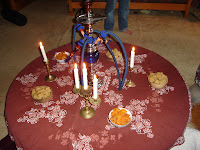
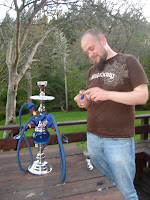
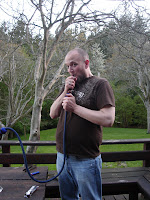
Halva, and Turkish Apricots Afterwards, Ben set up a houka for some to smoke...

and some of us just enjoyed the turkish coffee...or giggled our way through some belly dancing!

The night ended with a little talent sharing... poetry, banjo, piano, story reading... and an impromptu campfire on the beach.

Friday, August 8, 2008

Food Course: The Hungry Soul

The discussion this day focussed on food disorders: obesity, anorexia, bulimia, and the greatest food disorder, hunger. Mary Ruth explored three basic roots of all these disorders - geographic change, cultural change, and familial change.

The conversation about geographic change focussed on the effects of urbanisation, changes in the size and nature of farms, and the change in how we use our homes (especially how zoning and consumerism 'feed' our lifestyles in the latter). We talked about how cultural changes are shown in the denial of real stages of life (e.g. in fashion, aging or anti-aging, tween culture), conformity to a prescribed beauty, and denial of classic sources of wisdom (family, place, and self are replaced with media influences). Familial change reflected the impact of households where both parents work, changes in food preparation and preservation, and children's schedules that rival their parents.


Some possible small steps we discussed were:
  • refusing to buy into fads - thinking carefully before we buy/do things
  • choosing to walk - a way of promoting community, exercise, safety, slowing down...
  • reducing meat consumption - awareness of animal care issues, sourcing food resulting in intentionality, seasonal eating, meat flavour trumping size
  • modelling healthy attitudes to food and our bodies - acknowledging that most people hunger for love, joy, acceptance and approval... and that churches ought to be places of healing in these areas too
Our reading was from two books: Harvey Levenstein's "The Paradox of Plenty" and "In Defense of Food" by Michael Pollan. The quote I chose comes from the latter, page 81: “But the industry’s influence would not be nearly so great had the ideology of nutritionism not already undermined the influence of tradition and habit and common sense – and the transmitter of all those values, mom – on our eating.”


Our mindful meal this evening was an Indian meal with a focus on our senses. We started by washing our hands. The meal looked beautiful, as did the spice illustrations. We ate with our hands (even though we tried to use only one - as is traditional). We smelt all the beautiful spices as the group cooked and tried to identify them at the table. We tasted a wide variety of flavours: sweet, sour, salty, bitter, hot... And we heard the crack of poppadums, the crunch of radishes, the gentle whisper of naan scooping up dhal, and the satisfied sounds of diners as they tasted the chai tea icecream!
The menu was:
Appetizer - Poppadums serverd with Mango-Apple Chutney, Lime Pickle, Cucumber Raita, Cilantro (Coriander leaf)-Onion Relish Salad - White and Red Radish Salad Entrees (Mains) - Basmati Rice and Naan Bread with Baji Dhal (East Indian Spinach and Lentils) and Roasted Vegetables Dessert - Chocolate Cake with Chai Tea Ice Cream

This day also happened to be Mel's birthday, so the chocolate cake became a birthday cake...

complete with a hidden thimble - a la Nancy Willard's book, "The High Rise Glorious Skittle Skat Roarious Sky Pie Angel Food Cake" (illustrated by Richard Jesse Watson).

"Open your mouth and taste, open your eyes and see -- how good God is." Psalm 34:8

Saturday, July 26, 2008

Food Course: Food For the Household

Monday started with a class session discussing gardens, meals, and cooking. Mary Ruth talked about the gardens in The Bible. Eden and the garden where Jesus was laid in the tomb act as bookends to the salvation narrative. (I think the tree of life on each side of the river in Revelation 22 probably is a more fitting bookend). The garden of Gethsemane falls in the middle, a symbol of the opposite of both Eden & the world after Jesus' resurrection, despite its beauty. We talked about the 'more than' essence of Christian life, and the role gardening plays in being more than just producing food.
Meals are a means of celebrating culture, family, history and being mindful of God. Mary Ruth talked about creating a meal culture that cultivates these through table settings, companions, and thankfulness to God.
Our cooking discussion focussed on how we learn and teach basic cooking skills, practice economy, use gardens and make decisions about what we eat (or don't eat). My quote comes from Michael Pollan, In Defense of Food. "To eat slowly, then, also means to eat deliberately, in the original sense of that word: ‘from freedom’ instead of compulsion." (The subtitle is a good summary of his book: "Eat food. Not too much. Mostly plants.")
We then went to visit an organic 6-acre farm at the north end of Galiano, owned by Donna and Hans (friends of the Wilkinsons). It is a self-sustaining garden, that produces enough to supply a number of households on the island. Donna runs a CSA-type of arrangement with these families, makes preserves (like her yummy Kiwi, Blackberry & Orange Jam) and sells any extra veges at the local market. This place also reminded me of my grandparents' garden, but Grandad doesn't have to set (humane) beaver traps to protect his orchard!
While most of the class remained to help in the garden for an hour or so, I returned with my group to prepare our 'mindful meal'. More about that next post!

Food Course: Day 5

Our fifth day focussed on the connections between people, food and land. We broke our fast with challah bread and helped prepare the Seder meal.

Our discussions focussed on the gift of the promised land to the Israelites, a restoration of their relationship with God and the land. This was linked with the Passover and jubilee festivals, inaugurated in the Old Testament. We also discussed the implications of the new covenant in the New Testament and the heralding of God's kingdom on earth.

These discussions about people's broken relationships with the land led to a conversation about western farming practices, and how changes in the 1920s and 1930s (particularly in the US) advocated farmers (and farm land) as producers, rather than the established concept of farmers as nurturers of the land. We talked about bioregionalism, and the emergence of the conservation and environmental movements.

Our reading included excerpts from a couple of essays by Wendell Berry, one of Loren's favourite authors and poets. The quote I chose is from Berry's first chapter of "The Unsettling of America", page 12:
"But is work something that we have a right to escape? And can we escape it with impunity? We are probably the first entire people ever to think so. All the ancient wisdom that has come down to us counsels otherwise. It tells us that work is necessary to us, as much a part of our condition as mortality; that good work is our salvation and our joy; that shoddy or dishonest or self-serving work is our curse and our doom. We have tried to escape the sweat and sorrow promised in Genesis—only to find that, in order to do so, we must forswear love and excellence, health and joy."

Seder Meal

It was a natural conclusion to our days spent talking about biblical foundations for the understanding of food, to have a seder meal, a feast celebrated during the Jewish passover. As you can see, Mary Ruth and Loren really got into the spirit of things as our 'parents' presiding over the meal!We gathered around the specially laid table. Each setting was headed with a small plate of symbolic food, a shell, a wine glass, a bowl of salty water, and a booklet containing a form of liturgy. Here you can see the special Seder plate at the head of the table, which contains the symbolic food:
* a green herb (parsley) to be dipped in salty water - a symbol of new life coming from sweat and suffering in the past
* a lamb shank bone (from the roast lamb) - a reminder of the lamb eaten by the Israelites on the night God passed over their houses, sparing their first-born
* bitter herbs (horseradish, onion and lettuce) - a symbol of the bitter life of slavery under Pharaoh in Egypt
* charoset (a 'pebbly' mixture of apples, nuts and spices, moistened with wine), in which the bitter herbs are dipped - a symbol of the mortar and bricks the Israelites slaves made in Egypt
* an egg (hard-boiled or roasted) - a symbol of the cycle of life, and also a symbol of mourning the destruction of Jerusalem

The liturgy recalls the Israelites escape from Egypt, the goodness of God, and offers praise to God. I helped make the unleavened matzah bread (a bit like crackers - whole wheat flour, oil and water) that was broken and shared. The liturgy also encouraged the consumption of four glasses of wine. Given that we'd spent the previous day fasting (in line with our discussion earlier), we all poured very small portions!

Once the main part of the liturgy was complete we feasted! Chicken soup with matzo balls, roast lamb, salad, vegetables, and Passover cake for dessert (much like a sponge cake made with almond meal).
We were all very full by the end of the evening, as we finished the liturgy with praise and thanksgiving.

Thursday, July 24, 2008

Food Course: Days 3 - 4

Days 3 and 4 of the course were entitled "Biblical Foundations and Themes" and we delved into scripture to explore the ideas of Eden, Passover, kosher eating, feasting, fasting, sabbath, hospitality, justice and Eucharist.

Obviously that was a lot to cover, so here are some notes that have got me thinking:
1. Sabbath: In sabbath becoming Sunday, it loses its deep sense of peace...
* setting aside our own agendas
* appreciating what we have
* sharing what we have
* delighting in what we have
Sabbath is not a legalistic duty but linked to the creation narrative (with all its implications), centred on a meal. Any meal can be a mini-sabbath if it helps us slow down and appreciate God's goodness to us.

2. Eden: Genesis 2:15-17 sets God's agenda for creation and humanity. Man participates with God in the full flowering of creation. The garden is life-giving and comes with a prohibition (and consequences). Death is part of creation before humanity is created (think compost and geological findings about fossil fuels!) How is death as a punishment to be seen then? Sin is ultimately about our choice to separate ourselves from God. The immediate death in Eden is the fear, shame and discomfort that Adam & Eve suffer when they eat the forbidden fruit, breaking their communion with God. Alexander Schmemann, an Eastern Orthodox theologian, has more to say about the sacramental nature of life in For the Life of the World.

3. Hospitality: The covenantal relationships God has with humanity and creation are often sealed and celebrated with a meal (sacrifice or feast). In Genesis 18, Abraham welcomes his holy guests with a meal. In 2 Kings 6:8-23 a meal is the setting in which conflicts are solved. In some cultures (ancient & nowadays) a guest is considered 'family' once they have had a meal, or three cups of tea, or eaten bread... Even in the West today, food is used to break down social barriers, to build relationships, and celebrate people and remembered events.

4. Fasting & Kosher: One way show appreciation for God is to feast and be thankful; another is to refrain from eating certain foods, or for a period of time. This acknowledges that while food is a necessity, it can also become a temptation or idol. How and what we eat is important. In recognising our hunger, we recognise our need for and dependence on God.

The quotes I chose for these days are:
"The first, the basic definition of man is that he is the priest. He stands in the center of the world and unifies it in his acts of blessing God, of both receiving the world from God and offering it to God – and by filling the world with this eucharist, he transforms his life, the one he receives from the world, into life in God, into communion with Him. The world was created as the “matter,” the material of one all-embracing eucharist, and man was created as the priest of this cosmic sacrament" (Alexander Schmemann, For the Life of the World, 15).

This one just tickled my fancy! "Except ye munch the flesh of the Son of Man and drink his blood, ye have not life in yourselves" (Aileen Guilding, The Fourth Gospel and Jewish Worship, 59, [quoting John 6:53, my italics]). No wonder the early Christians were thought to be cannabilistic in their worship of Christ! But surely we would gain more life if we really savour our relationship with Jesus.

"In the eucharist the curse is undone and paradise restored. Instead of the eating that brought death there is offered the eating that brings eternal life. The… Eucharistic bread as the antidote to the forbidden fruit of Genesis 3” (Guilding, 63).

Food Course: Day 2

Okay, so I haven't been on the food course for the last 2 months, but here is my attempt to begin to catch you up with what has happened (briefly!)

Day 2 was entitled "Eating to Live / Living to Eat" and our lecture and discussion focussed on the flow from the biology... to ecology... to philosophy... and to theology of eating. We talked about the need to eat and how our bodies use food, especially about the misleading analogy of the body as a machine (machines burn fuel, while bodies are rebuilt by the food we consume). We discussed agriculture as a simplified form of a natural ecosystem, which in itself can also be a large threat to the natural ecosystem! The philosophical and theological discussions ended up melding into one discussion but I can't really sum it up in a sentence. We ranged far and wide!

The quote I chose for today was from Animal, Vegetable, Miracle by Barbara Kingsolver (page 10): “I used to take my children’s friends out to the garden to warm them up to the idea of eating vegetables, but this strategy sometimes backfired: they’d back away slowly saying, ‘Oh man, those things touched dirt!’”
Kingsolver's book was an easy, informative, and entertaining read. Her website continues the story from her book, which documents her family's move to a farm in the Appalachian countryside.

Wednesday, May 7, 2008

Food Course Intro

I am currently on a course called "Food: Creation, Community, and Communion," held on Galiano Island, one of the Gulf Islands off the west coast of British Columbia. I am one of 25 Regent College students who are privileged to be participating in this course in its inaugural offering. It is being taught and hosted by Mary Ruth and Loren Wilkinson, who have taught me (separately) in other courses I've taken at Regent.

So far, we have had a busy time. Our general daily rhythm is lectures in the mornings and rest or chores in the afternoons. We have 50+ pages of reading for each class and some evenings we watch food related movies.

On Sunday night the class arrived at Galiano Island (rather late) and we had gingerbread for dessert and settled into our places of sleep. I am staying at the Fee/Martin house, about 7 minutes walk from the Wilkinson's farmhouse. It has a beautiful view of the water, looking out on Salt Spring Island.

Monday morning saw us consume crepes and multiple toppings for breakfast, before our first lecture in the Wilkinson's living room. Our scripture reading was from Luke, where Jesus invites his disciples for breakfast on the beach. We then introduced ourselves to the class, saying where we were from (before Regent) and why we had come to the course. It was amazing how diverse and how similar many of our answers were!

Mary Ruth then spoke about the main components of a meal: tongue, table, guests and grace. She read two children's books, An Angel for Solomon Singer and Mrs Moskowitz and the Sabbath Candlesticks, and based her lecture on our two readings (selections from Margaret Visser, The Rituals of Dinner, and Leon Kass, The Hungry Soul). It was interesting to see how aspects of a meal we take for granted are quite significant in "being human."

For lunch we had nettle soup (yes, some of the nettles we picked and prepared, Nath) and "biscuits" (scones). Then my group had a 'rest day' so I read and napped in the afternoon.

I picked my 'daily quote' from the required reading for our class anthology from Visser, page 14: "…(the Maori word tapu is the origin of our “taboo”)…" It formed part of a discussion of the etiquette of cannibalism amongst Maori and other cultural groups! I thought it was particularly interesting, given my understanding of tapu as holy, and its use for conserving resources in local areas.

Dinner was kedgeree. Yum! It was an opportunity to put some 'cultural context' around the food. I know kedgeree as a British breakfast dish, derived from India (when occupied by the British). This was confirmed by our two UK students, Debbie and Esther. I explained this to Soohwan, our Korean friend who has spent a lot of time in Bangladesh, and she laughed: "Kidgeree is a dish made from leftovers or the mash fed to babies! I've never had it with smoked fish."

After dinner there was a showing of a Danish film (with subtitles), Babette's Feast. It explored community, acceptance, gratitude, and generosity. A fine way to end our first day.